The Sign in the Yard: On Political Speech and the People Next Door
Sometime in the last two weeks, the street changed. Not the trees. Not the light, though that changed too. The change was at ankle height: a row of small rectangles standing at the edge of every lawn, each one wired into the grass at roughly the same angle, facing the same direction, all of them saying something to whoever drives past. You can now read your street’s politics from a moving car. Nobody told you. Nobody asked.
I put one up once. I remember pushing the wire legs into the ground, which took about four seconds, and then standing back to check that it was straight. That was the entire act. For the next five weeks I lived on a street where I had made a public statement I could not revise, could not qualify, and could not take back without somebody noticing.
A sign is a sentence with a stake in the ground
Compare it with the other ways we say political things. A bumper sticker travels with you, so it reaches strangers who will never see you again. A post online reaches people who chose to follow you, or chose to open the app. A letter to the editor passes an editor before it reaches anyone. Each of those has an escape hatch built in, whether distance, consent, or somebody standing at the door deciding whether it runs.
The yard sign has none. It is addressed to a captive local audience and it stays addressed to them. The mail carrier sees it four times a week. The woman two doors down sees it from her kitchen window while she does the dishes. The kid walking to the bus stop learns, years before he can vote, which houses are which.
Building all of that out of corrugated plastic and two wire legs is a strange thing to do, and the strangeness is the part worth examining. The sign is cheap, mass produced, identical to ten thousand others, printed in two colors and a typeface chosen for legibility at thirty miles an hour. We treat it as self expression anyway, a small flag planted by a person who means it.
You own the lawn. You don’t own the view
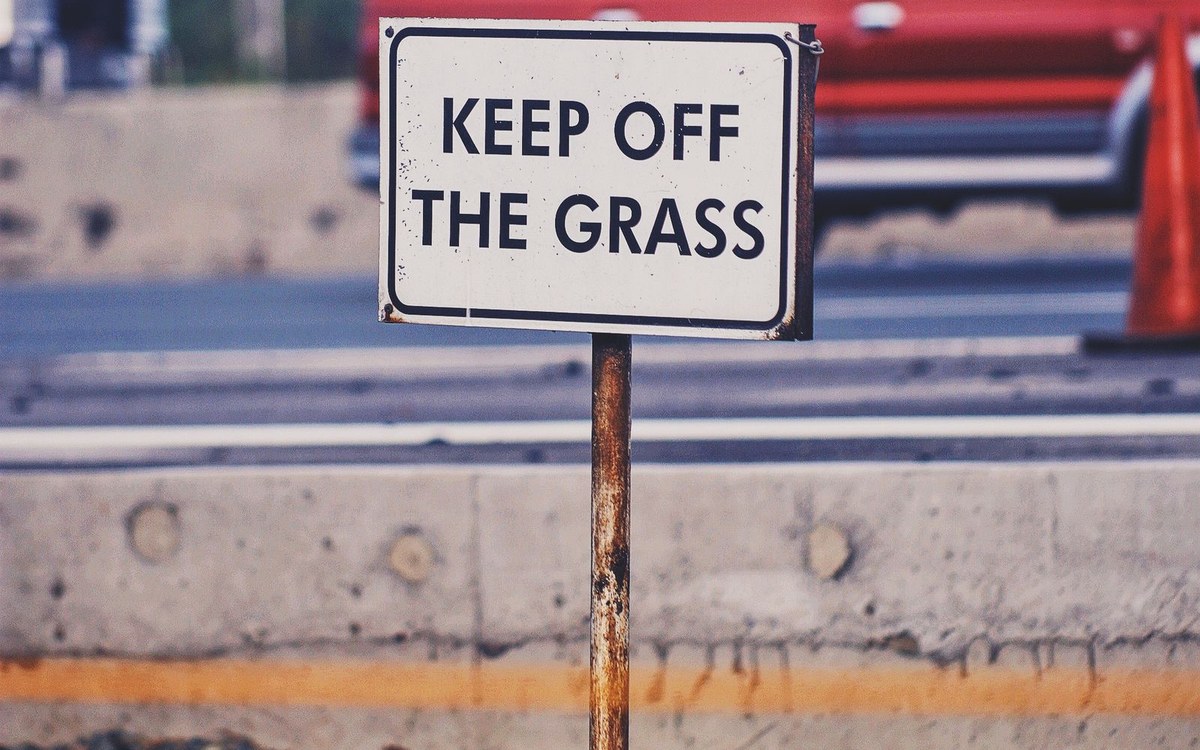
There is a tidy version of this argument that ends the conversation too early: it’s my property, so it’s my speech. That is legally correct and ethically incomplete. The sign stops at the property line. The message does not. It crosses the strip of grass, the sidewalk, the road, and lands in somebody else’s field of vision, where it will sit for weeks.
We already have a category for this. Neighbors broadcast at each other constantly and mostly without permission. A dog that barks at six. A floodlight aimed at a bedroom window. A trampoline that turns a quiet yard into a shouting yard every Saturday. Some of that we tolerate because the alternative is a street of people keeping score, and some of it we regulate badly through noise ordinances and fence height rules and the long unwritten negotiation about what counts as too much. The same logic covers the bit of ground between sidewalk and curb, that strip of public space nobody feels responsible for, where a sign is usually planted and where the question of who the street belongs to gets answered by whoever gets there first.
The sign belongs to that family of small impositions, though calling it an imposition undersells it. Farhan Samanani’s essay on shared public space draws a useful distinction here. Frame a shared space as a contest of rights and each party can make an argument that sounds reasonable on its own, yet the arguments never add up to a way of living together. What makes shared space usable is closer to trust: an expectation that other people will make some effort to accommodate you, and a willingness to extend the same. Rights tell you where your claim ends. They do not tell you how much of it to use.
The porch light is the same real estate doing the opposite job. A light left on says come to the door; a sign driven into the lawn says I am here and you may not like what I think. Both are signals hung at the boundary of a house, and both depend on neighbors who are willing to read them in good faith.
The block already knows, and that’s the trouble
Set persuasion aside for a moment. Whatever a sign does to a swing voter, it does something much more reliable to a street: it publishes a census.
Before the signs go up, your neighbors’ politics are guesswork, and most of us do very little guessing. We know who lends tools, whose dog gets out, who waves. That thin, agreeable ignorance is one of the underrated goods of suburban life. It lets you like a person whose vote you would find appalling, because you have never had to think about their vote. The sign ends that, not because it tells you anything surprising, but because it makes the information impossible to avoid.
There is a second effect, subtler and harder to forgive. Once most lawns carry a sign, the empty lawn becomes a sign. Not displaying is now a display. A house with nothing in the yard reads as indifferent, or as a quiet vote for the other side, and which one you get depends entirely on who is doing the reading. The person living there never agreed to answer the question. The street asked it anyway, by consensus, without a vote.
The escalation is not about conviction
Watch what happens across a few weeks. The first signs go in early and belong to the people who were always going to put one up. Then the lawns around them fill in. Then somebody’s sign is larger than the others. Then somebody puts up two. Then a house that had nothing displays a hand painted plywood version, which is a different kind of statement entirely, and by the end of October the street carries a hierarchy of enthusiasm that nobody planned and nobody can opt out of.
Most of that escalation is driven by the fear of being misread rather than by deepening belief. If a sign on your lawn signals which side you are on, then a bare lawn begins to signal something too, and the cheapest way to correct a misreading is to plant a sign. The street ends up with more signage than conviction, each new rectangle a reply to the rectangle next door.
All of it is compressed into a format that cannot argue. A sign says who, not why. It is a conclusion with the reasoning stripped off, standing in the weather. That is fine for a bumper sticker, which nobody expects to persuade anyone of anything. It is an odd object to install in front of your house, where the people who see it are the people you will need to borrow a ladder from in March.
The law got here first, and it did not settle anything
American towns have fought about this for decades, mostly through sign ordinances. Cities tried sorting signs into categories and treating each category differently: political signs, ideological signs, temporary directional signs for a church rummage sale. In 2015, in Reed v. Town of Gilbert, the Supreme Court struck down one town’s sign code because those categories were themselves content based. A code that gives a political sign more time on the lawn than an ideological one is a code making an editorial judgment, and the First Amendment does not permit that even when the judgment is polite. Towns rewrote their rules afterward, mostly by making them about size, duration and placement instead of message.
The case matters for a reason that has nothing to do with doctrine. It shows how thoroughly the law has already worked through whether you may put a sign on your lawn. You may. That question is closed, and no neighbor gets to relitigate it by glaring across the hedge.
What the law cannot do is write the etiquette. It can tell you when a sign may go up and how large it may be. It cannot tell you that the kid next door is having a hard week and that the sign is the thing he reads every morning on the way to school. Constitutional protection draws the outer boundary of the permission. Everything inside that boundary is left to us, and we are not especially good at it.
The morning after
On the Sunday after election day, every sign on the street has changed meaning without moving. Before the vote, a sign is a claim about the future: this is what should happen. After the vote it becomes something else, and which something depends on the result and on the person. It can be a flag kept flying. It can be a grievance. It can be a keepsake. It can be a piece of plastic nobody has gotten around to.
Most of them stay up for weeks, and the reason is rarely laziness. Taking the sign down feels like conceding something, even to people whose side won. The sign was the loudest thing you did all year, and pulling it out of the ground is a small admission that the loud part is finished.
The courtesy here is straightforward, and it runs both ways. If the sign was about the election, take it down when the election is over, quickly enough that nobody has to stand in their driveway wondering what it means now. If you intend to leave it up, leave it up on purpose, knowing that it has become a statement about the result rather than the race and that your neighbors will read it that way. What is worth asking of each other is legibility: say the thing you mean to be saying, and stop saying the other thing.
What the sign is actually asking for
Strip away the policy and the partisanship and something almost tender is left. A person stands in their own front yard, pushes two wires into the dirt, steps back, straightens the sign, and goes inside. Nobody is watching, usually. The act is performed for a street that will notice later.
That is a request for acknowledgment more than a demand for agreement, which is a much cheaper thing to give and much rarer than it should be. Applause works the same way in a room: we clap to register that we were present for something, and the clapping is only loosely connected to the quality of what we saw. The sign says I live here, this matters to me, and I am willing to be known for it by people who might not like it. On a street where most of us work hard at being pleasant and vague, that is a small risk taken in public.
Which leaves two honest responses, and no obligation to choose the friendlier one. You can let the sign stand there and mean exactly what it says, without upgrading it into a verdict on your neighbors or a prediction about the country. Or you can treat it as an opening and ask the person about it, and find out what a sign cannot tell you.
The thing to avoid is what most of us actually do: drive past it forty times, let it settle into a fact about the street, and never mention it once. A sign nobody discusses is a conversation we had in silence, badly, for five weeks.