
The Handshake Is Dead: What Touchless Greetings Tell Us About Trust in a Fragmented Age
I was at a conference last month when someone extended their hand toward me, then pulled it back mid-motion and turned it into an awkward wave. We both laughed, but the moment sat with me longer than it should have. That tiny hesitation — the micro-second where a person decides whether to touch a stranger — is the surface of something deeper.
The handshake has been the default greeting in Western cultures for centuries. Its origins are practical — showing that neither party holds a weapon — but its persistence is cultural. A firm handshake signals confidence. A limp one suggests weakness. The handshake closes a deal, seals an apology, starts a relationship. In its quiet way, it is one of the most important pieces of social infrastructure we have.
And it is in clear decline.
Pandemic-era distancing gave us permission to stop touching each other. What started as public health protocol has become a lasting shift in how we initiate contact. According to a 2023 survey by the Pew Research Center, 47 percent of American adults say they shake hands less often than they did before 2020. Among adults under 30, the number jumps to 62 percent. A whole generation is growing up without the handshake as a reflex.
At first glance, this looks like a loss. And in some ways it is. The handshake is an efficient trust signal. It communicates intention in a fraction of a second. Two people extend their hands, and in the grip — firm but not crushing, brief but not rushed — a mutual understanding passes between them. You cannot fake a handshake the way you can fake a smile. The physical contact leaves no room for ambiguity.
The decline of the handshake is not only about germs. It sits on top of a deeper shift in how we relate to each other, and that shift is worth examining.
What the handshake actually does

The handshake is a remarkably compact piece of social technology. In a single gesture it accomplishes four things: it establishes proximity, signals peaceful intent, initiates physical contact, and synchronizes the start of an interaction. The anthropologist Desmond Morris, in his book The Naked Ape, argued that the handshake evolved from the practice of grasping forearms to check for hidden weapons. A security check that became a ritual.
But rituals do not survive on utility alone. They survive because they encode meaning. The handshake carries weight beyond its function. When you shake someone’s hand, you are offering a piece of your physical self, saying without words that you trust this person enough to let them close. That is not a small thing.
In societies where handshakes are less common or have different forms — Japan’s bow, Thailand’s wai, the Maori hongi — the greeting still performs the same function. It creates a shared moment of vulnerability and acknowledgment. The specific mechanics differ, but the underlying ethics are the same: I see you. I acknowledge you. I am willing to meet you in this space.
This is the part that gets lost when we focus only on the handshake’s decline. The handshake itself is not the point. What matters is the willingness to perform a ritual of trust with another person. The real crisis is constructing fewer rituals of trust, not shaking fewer hands.
The rise of the touchless greeting
The alternatives that have emerged in the handshake’s wake are revealing. The elbow bump was briefly celebrated as a pandemic workaround, but it never really caught on because it is terrible. An elbow bump communicates nothing. It is functional contact without any of the symbolic weight. The same goes for the foot tap, the namaste wave, and the closed-fist pound that hovers somewhere between a real gesture and a joke.
What has actually replaced the handshake, especially among younger people, is the nod. A slight downward dip of the head, sometimes paired with eye contact, sometimes not. The nod is the minimalist greeting. It says “I acknowledge your presence” without saying anything about trust, intention, or willingness to engage. It is a greeting designed for people who are not sure they want to be greeted.
This mirrors something larger. The nod is the greeting of a fragmented society. It is what you do when you pass someone on the street in a city where you do not know your neighbors. It is the minimum viable recognition of another person’s existence. For a growing number of people, that is all they want to offer.
I wrote about this dynamic before when discussing the unwritten codes that govern behavior in communities. The same principle applies here: when the formal rituals of trust disappear, weaker signals take their place.
What other cultures can teach us
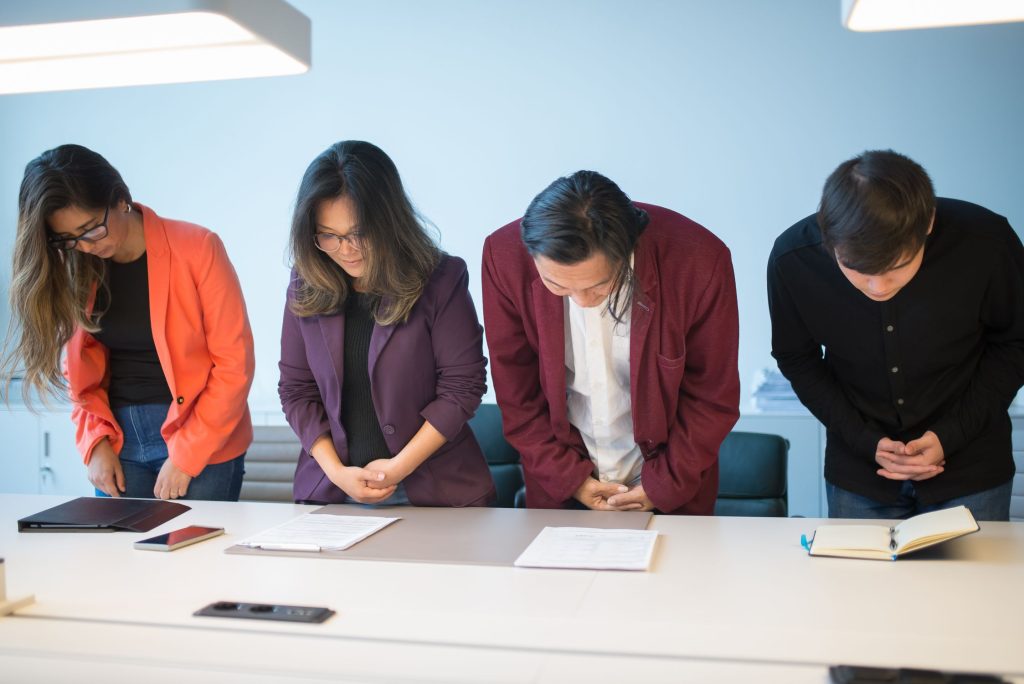
Japan offers an instructive contrast. The Japanese bow is not a greeting that can be replaced with a nod without losing something essential. The angle of the bow communicates status, context, and relationship depth. A fifteen-degree bow is for casual greetings. Thirty degrees shows respect. Forty-five degrees is reserved for formal apologies or deep deference. These are not arbitrary distinctions. They are a finely tuned system for encoding social information in a single gesture.
Japanese culture never needed a handshake pandemic to stop touching each other. Its greeting ritual was already touchless, and already carried meaning. The bow works because everyone agrees on what the different angles mean. It requires no physical contact, but it requires a shared understanding of the code. That shared understanding is what we are losing.
The Western response to the decline of the handshake has been to grab at whatever replacement is most convenient. We have not built a new greeting code. We have defaulted to the lowest-effort option. The nod acknowledges presence but does not establish trust. The Aeon essay “Thought-tinkering” on the philosopher Byung-Chul Han makes a similar point about how Western greetings assert bounded individual selves, while Eastern rituals express something more relational.
There is a lesson here from how subcultures develop their own greeting codes. Bikers, for instance, have elaborate hand signals and head nods that communicate clan affiliation, road conditions, and whether a rider needs help. These greetings work because the community shares a context. The gesture is shorthand for a whole set of shared experiences. When the greeting code collapses into just a nod, you lose that context. All that remains is the acknowledgment.
What greeting rituals actually protect
The stakes here go beyond etiquette. As the Psyche article “Defining social trust is a first step toward nurturing it” explores, social trust in strangers is the foundation of cooperation. Greeting rituals are trust bootstrap mechanisms. They create the initial conditions for cooperation between strangers. A society that loses its greeting rituals does not merely become less polite. It becomes harder for strangers to initiate cooperation at all.
I am not making a nostalgic argument for bringing back the firm handshake. I am arguing for taking greeting rituals seriously, whatever form they take. The problem is the loss of any meaningful ritual of first contact that encodes more than “I see you.”
The research on this is striking. A 2019 study in the Journal of Experimental Social Psychology found that even a brief handshake before a negotiation increased cooperative outcomes by 23 percent compared to no physical greeting. The tactile contact created a baseline of trust that persisted through the entire interaction. No amount of polite nodding achieves the same effect.
And yet the handshake is not coming back in its previous form, at least not broadly. The question is whether we will replace it with something that works — not just a gesture that avoids germs, but one that rebuilds trust. If the response to the pandemic’s disruption of greeting rituals is to abandon meaningful contact altogether, we lose more than a handshake. We lose one of the few remaining low-friction mechanisms for turning a stranger into someone we can work with.
The deeper problem
I keep coming back to the conference moment. The hesitation, the mid-motion correction, the awkward wave. That pause is not really about the pandemic. It sits on top of a culture that has lost confidence in its own rituals. We no longer know what the correct greeting is, so we improvise in real time. Improvisation, when it comes to trust, is not a substitute for a shared code.
The philosopher Kwame Anthony Appiah, writing about honor codes in The Honor Code, argued that moral revolutions happen not when people change their minds, but when certain behaviors become dishonorable. The handshake is not heading toward dishonor. It is just becoming optional. Optional rituals, in practice, become optional trust. You can take them or leave them. But when everyone is deciding individually, the collective signal gets lost. The greeting becomes noise instead of a signal.
Cultures have lost greeting rituals before. The European kiss on both cheeks has been in decline for decades. The tipping of the hat disappeared within a generation. But those were regional or class-specific practices. The handshake was more universal. Its decline touches everyone.
This connects to something I touched on in my piece about queuing as a moral technology. The queue works because everyone agrees on the rules. The handshake worked for the same reason. When the agreement breaks, the ritual is just a gesture with no shared meaning attached.
What we build next
I do not have a tidy answer here. I suspect the replacement for the handshake will not be a single gesture but a fragmented set of context-dependent signals. People will read the room and decide: nod, wave, fist bump, or maybe — if the situation calls for it — a handshake after all. This flexibility has its advantages. But it also demands more social labor from every individual. You cannot fall back on the default. You have to choose, every time, how to signal trust to a stranger.
That is exhausting. Exhaustion, when it comes to social interaction, tends to lead to withdrawal. The easier option is not to greet at all. But that path leads to a world where strangers never become acquaintances, and acquaintances never become collaborators. As I wrote in “The Right to Look Away,” there are times when protecting your attention is necessary. But the first greeting is not one of them. It is the first step in a chain that ends in community. If we let the first step break, the rest of the chain does not hold.
The handshake may be dead. The need for what it did is not. We will have to build something else. The question is whether we build it deliberately, or whether we default into a world where nobody touches anybody, and trust becomes just another thing we used to know how to do.